 3' of reading
Many companies are interpreting Directive (EU) 2023/970 primarily as a matter of pay transparency, focusing on information, rules, and internal communication.
While this is a necessary step, it is not the decisive aspect.
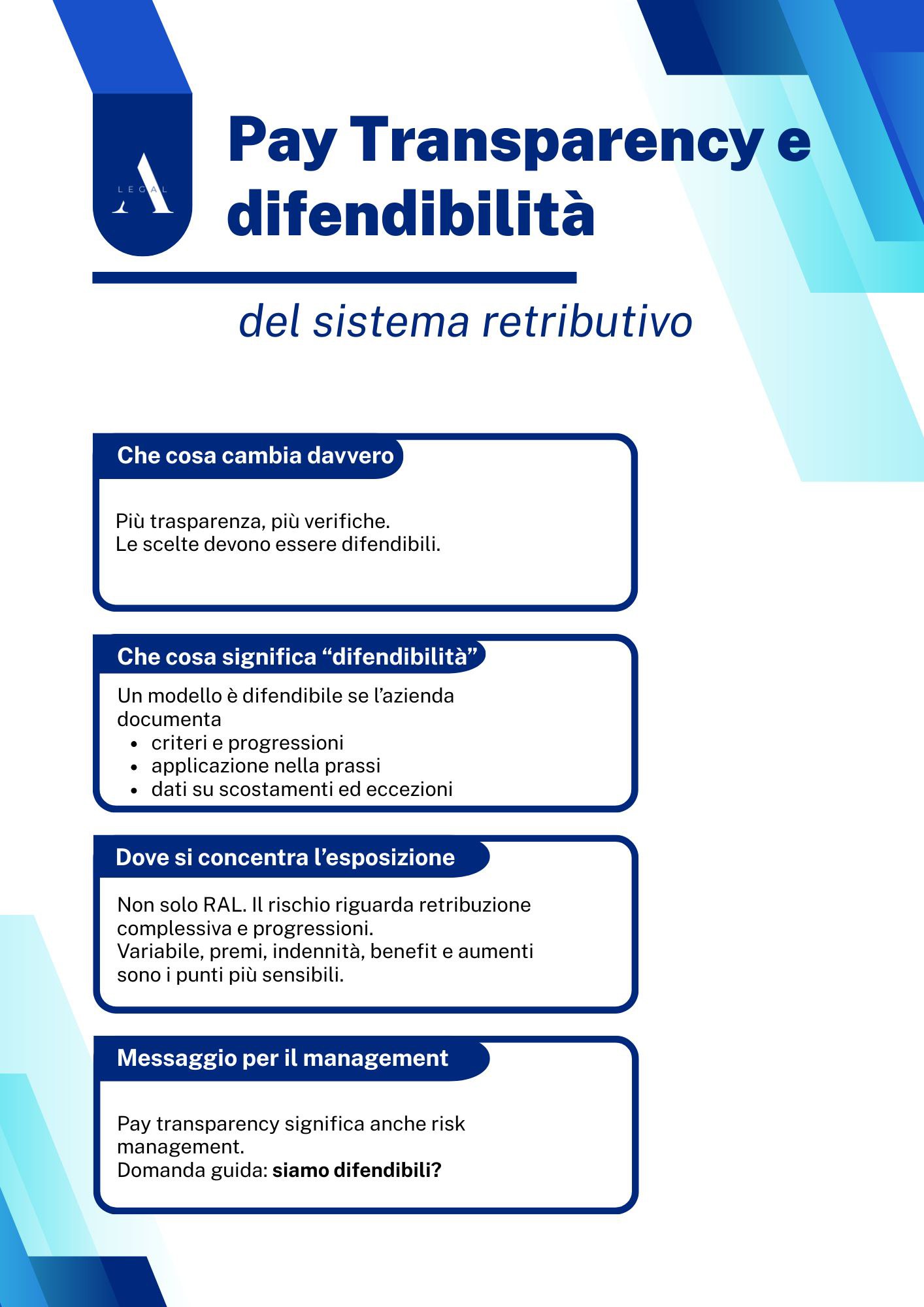
The most significant impact is that transparency exposes the compensation system to questions, comparisons, and requests for access to information.
In this context, it is no longer sufficient for decisions to be merely “reasonable.”
They must be capable of being reconstructed and substantiated consistently, even over time.
This brings the defensibility of the compensation model to the forefront.
Defensibility refers to the organization’s ability to present, in an orderly and verifiable manner, the criteria used to determine pay and career progression, how those criteria are applied in practice, and the evidence available to monitor deviations and exceptions.
In practice, organizational weaknesses are rarely attributable to unlawful managerial decisions.
More often, they stem from the absence of an adequate documentation framework, whereby the rationale behind decisions is reconstructed only ex post, rather than being formally documented and tracked in advance.
The areas of greatest exposure concern total compensation and mechanisms for increases and career progression.
Risk increases when differences become entrenched through informal practices or case-by-case exceptions, without a clear and traceable governance framework.
Another key issue concerns the comparability of roles, in light of the principle of equal pay for equal work or work of equal value.
This requires a consistent foundation regarding roles, grades, responsibilities, and evaluation criteria, in order to reduce discretion and internal vulnerability.
For management, pay transparency also functions as a risk management safeguard.
It improves the quality of responses to employee requests, reduces the risk of union escalation, strengthens the company’s position in the event of litigation, and mitigates reputational risks linked to perceived inconsistencies.
The Law Firm remains available for any further clarification.
